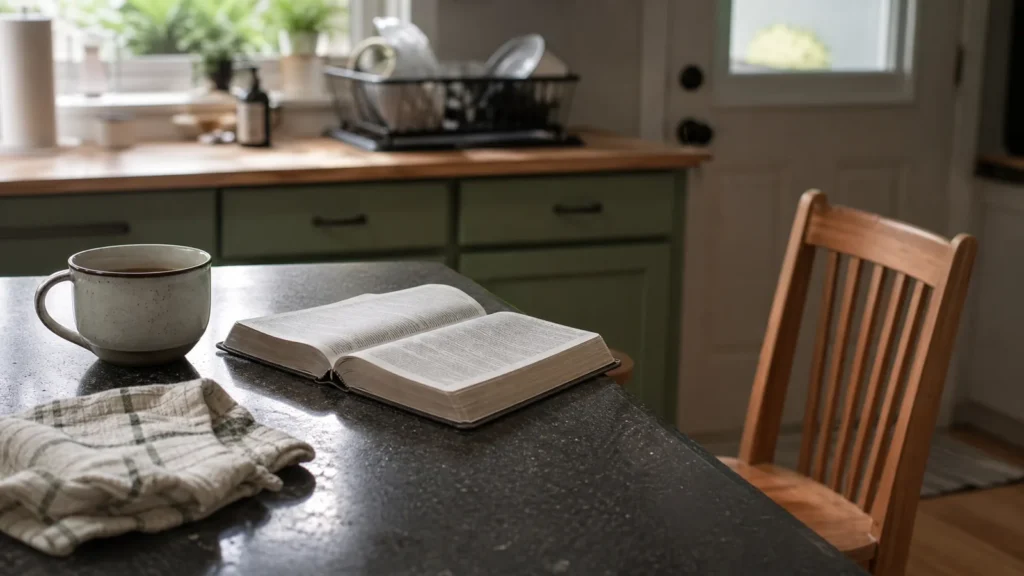
Sometimes prayer feels like the last unchecked box at the end of the day.
You meant to sit down earlier. You meant to read the passage slowly, gather your thoughts, and say something faithful. Now you are tired. The words will not arrange themselves.
Then guilt adds its voice:
You should want to pray.
You should know what to say.
You should be better at this by now.
For a moment, set down the expectation that you need to pray well.
Romans 8 does not describe people who have escaped weakness. Paul writes about creation groaning under what is broken. He writes about believers groaning while they wait for what God has promised but they cannot yet see.
The passage is full of hope. It is also honest about the sound of waiting.
Then Paul writes:
In the same way, the Spirit also helps our weaknesses, for we don’t know how to pray as we ought. But the Spirit himself makes intercession for us with groanings which can’t be uttered. He who searches the hearts knows what is on the Spirit’s mind, because he makes intercession for the saints according to God.
Romans 8:26-27, WEB
Notice where the Spirit meets us: in our weakness.
Not after we become focused.
Not after we find the right words.
Not after we feel sufficiently spiritual.
Paul says that sometimes we do not know how to pray as we ought. He does not turn that confession into another assignment. He turns our attention to the Spirit, who is already at work.
Sometimes we do not know which outcome to ask for. Relief or endurance? An open door or courage to remain? An answer now or patience for another day? Paul leaves room for prayers shaped by uncertainty. The Spirit knows what we cannot.
Creation groans. We groan. The Spirit intercedes with groanings beyond speech. Our unfinished prayer is held inside a much larger movement of longing and hope.
This does not make silence a special achievement. It does not mean words are unimportant. Scripture gives us words to borrow, and the church gives us people who can pray beside us when our own language is thin.
But prayer is not a performance in which silence earns a failing grade.
The God who searches hearts does not need a polished report. The Spirit’s help does not depend on your eloquence.
Perhaps all you have is a name.
Perhaps you have one honest sentence.
Perhaps you have a question you cannot finish.
You may bring that much. You do not have to fill the quiet to prove that you came.
A Gentle Practice
Let this prayer be small enough to carry.
Open your hands, if that posture is comfortable, and say:
Spirit of God, help me in my weakness.
Name one person or concern. Use only the words you have.
Then stop. Do not measure the silence or search for a particular feeling. For one minute, let Romans 8:26 remain true without requiring yourself to add anything:
The Spirit makes intercession for us.
When the minute ends, you may continue or return to your day. A short prayer is not an unfinished version of a better one.
Prayer
Spirit of God, I do not know how to hold every need before you. You know the words I cannot find and the hopes I cannot explain. Meet me in my weakness. Receive the names, questions, and silence I bring. When prayer feels like another task to complete, remind me that you are already at work. Teach me to come honestly, without pretending and without fear that my words must be enough. Amen.
Reflect
What expectation about prayer makes it difficult for you to begin?
Continue
Next: You Do Not Have to Pretend You Are Fine
Scripture: Romans 8:22-27, World English Bible.
Written by: Hannah Reed
Scope: This devotional offers Christian spiritual support and education. It does not provide medical advice, diagnosis, treatment, therapy, or crisis services.