Some work becomes visible only when it is not done.
The appointment no one scheduled. The groceries that appeared before the cupboard was empty. The form remembered, the ride arranged, the question asked before a small problem became a large one.
When you carry work like this for long enough, the strain is not only that there is too much to do. It is that people may begin to know the work without knowing the person doing it. You can start to feel like a function: the one who remembers, provides, organizes, or stays late.
Genesis 16 tells a story far more severe than an overloaded day. Hagar is an Egyptian woman enslaved in Abram and Sarai’s household. Sarai gives her to Abram in an attempt to obtain a child through her. Hagar’s body and future are treated as means to someone else’s purpose.
After Hagar conceives, conflict grows. Abram leaves her under Sarai’s power, Sarai deals harshly with her, and Hagar flees toward the wilderness.
We should not shrink her story into a lesson about being busy. Hagar is not merely underappreciated. She is a woman without the freedom held by the people making decisions about her life.
Then the story changes direction.
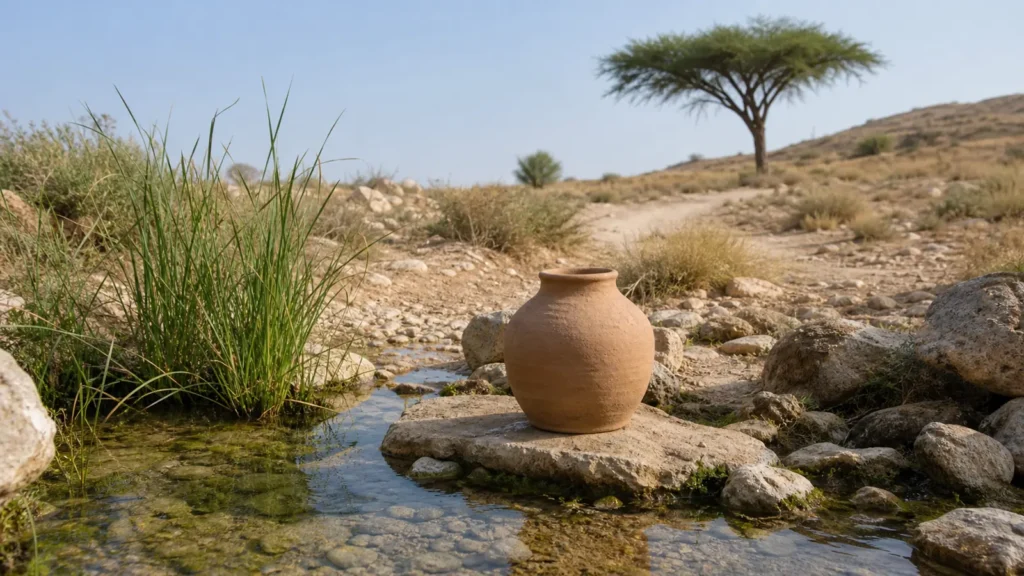
The LORD’s angel found her by a fountain of water in the wilderness, by the fountain on the way to Shur. He said, “Hagar, Sarai’s servant, where did you come from? Where are you going?”
Genesis 16:7-8, WEB
The messenger finds her. Hagar is not required to make herself important enough to be noticed.
And the first word spoken to her is her name.
Abram and Sarai have spoken about Hagar as a servant they can use and control. At the spring, she is addressed as a person. She is invited to speak about where she has come from and where she is going.
Hagar answers the first question: she is fleeing from Sarai. She does not answer the second. Perhaps she does not yet have an answer. The text does not tell us.
What follows is difficult. The messenger tells Hagar to return and submit to Sarai. Readers and interpreters have long wrestled with this command because the same chapter has named Sarai’s harsh treatment.
We should not explain that difficulty away. And we must not turn one command in Hagar’s particular story into an instruction for someone to return to abuse or remain unsafe. Genesis 16 does not give us permission to send a vulnerable person back to harm.
The messenger continues with a promise about Hagar’s descendants and tells her to name her son Ishmael, because the LORD has heard her affliction. In a household where powerful people have decided what her life will be for, God speaks directly to her about her child and her future.
Hagar responds with words of her own:
She called the name of the LORD who spoke to her, “You are a God who sees,” for she said, “Have I even stayed alive after seeing him?”
Genesis 16:13, WEB
Being seen does not make the injustice in Hagar’s story acceptable. It does not mean that every circumstance changes at once. It means the household’s failure to honor Hagar is not the final truth about who she is.
She is more than the role imposed on her. More than the outcome others want from her body. More than the work they expect her to perform.
God finds Hagar, calls her by name, hears her affliction, and receives her speech. The person treated as secondary becomes the person who names what she has learned about God.
That does not make our ordinary hidden labor equivalent to Hagar’s suffering. But her story does correct a lie that often grows around invisible work: that being overlooked means you are only what you provide.
You are a person before you are a function.
Bring One Task Into the Light
Choose one responsibility you have been carrying silently. Not the whole list. Just one.
If it is safe to do so, name it to one trustworthy person who can help decide how it should be carried: “I have been managing this, and I need you to know it is taking time and energy. Can we decide together what happens next?”
The conversation may not solve the problem. You are asking that this part of the work be seen and considered, not proving that you deserve care. If no such person is available, you can name the responsibility privately before God. The absence of reliable help is not a failure on your part.
Prayer
God who found Hagar in the wilderness, you know my name before you count what I accomplish. See those whose labor, suffering, and dignity have been ignored. Keep your people from using Scripture to excuse harm. Give me honest words for one responsibility I have carried in silence, and give others the courage to listen and share what should be shared. Teach me to receive my life as more than a service I provide. Amen.
Reflect
Where have you begun to confuse being needed with being fully known?
Continue
Related: Receiving the Day’s Limits
Related: Boundaries, Caregiving, and Loving Your Neighbor
Next: Loving Others Without Disappearing
Scripture: Genesis 16:7-13, World English Bible.
Written by: Naomi Carter
Scope: This devotional offers Christian spiritual support and education. It does not provide medical advice, diagnosis, treatment, therapy, or crisis services.