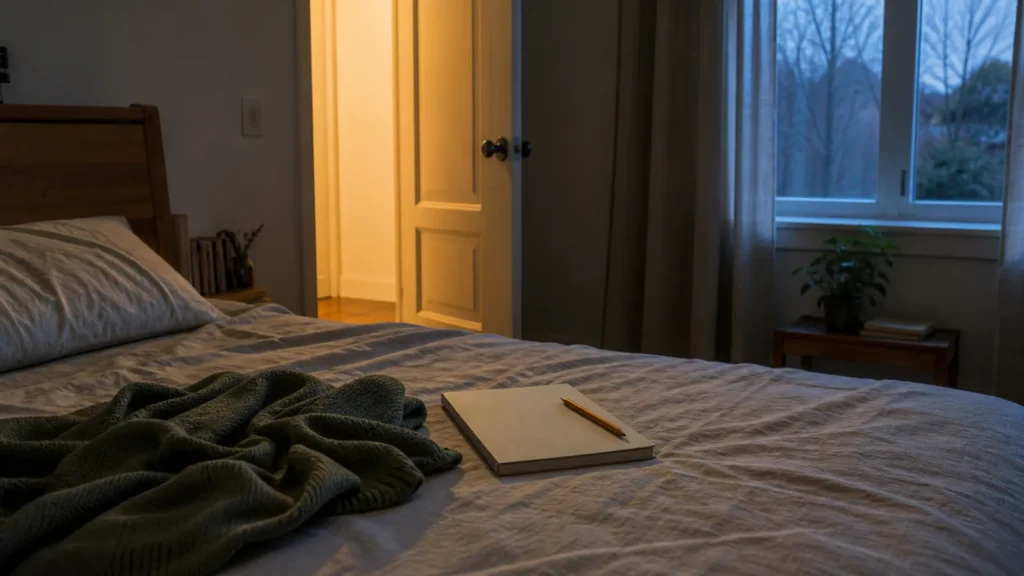
The lamp is off. The house has settled. Your body is asking for rest, but your mind has begun another round of the day.
It returns to the words you wish you had changed. It counts what remains unfinished. It moves ahead to tomorrow and then back to something that happened years ago.
You do not need to make those thoughts disappear before you pray.
Psalm 4 has often been received as an evening prayer. It mentions the bed. It ends with lying down and sleeping. But the psalm does not begin in quiet.
It begins with a cry:
Answer me when I call, God of my righteousness.
Give me relief from my distress.
Have mercy on me, and hear my prayer.Psalm 4:1, WEB
The psalmist is dealing with dishonor, falsehood, anger, and the question many people are asking: “Who will show us any good?” The exact situation is not explained. The prayer moves from God, to other people, to words that may also be spoken to the self.
That movement feels familiar at night.
One moment you are praying. The next, you are answering someone who is not in the room. Then you are trying to reason with your own heart.
Psalm 4 does not shame this unsettled movement. It brings it into the presence of God.
In the middle of the psalm comes this instruction:
Search your own heart on your bed, and be still.
Psalm 4:4, WEB
Being still here is not pretending the conflict is gone. The psalmist has already named distress. The invitation is to stop letting distress decide the next harmful word or action. The bed becomes a place to tell the truth, to pause, and to remember whom the psalmist trusts.
Only then does the final sentence arrive:
In peace I will both lay myself down and sleep,
for you alone, LORD, make me live in safety.Psalm 4:8, WEB
These are beautiful words to borrow. They are not a guarantee that every faithful person will fall asleep quickly or remain asleep all night. The psalm records one worshiper’s trust; it does not turn sleep into a test of yours.
You may pray verse 8 and still be awake.
You may trust God and still need to write something down, drink water, adjust the room, or ask for appropriate help when sleep difficulty persists or disrupts daily life.
Prayer does not have to force an outcome to be real prayer.
Tonight, trust may be smaller than sleep. It may be the decision to stop holding court with a conversation that cannot be repaired before morning. It may be naming one unfinished thing and allowing it to remain unfinished in the care of God, who remains present through the night.
A Gentle Practice
Choose one thought that keeps returning. Give it one sentence:
God, this is what remains unfinished: ________.
If there is an action for tomorrow, write it down. Then say:
I do not have to complete it in this bed.
Place one hand open on the blanket or beside you. Pray the final line slowly:
You alone, LORD, make me live in safety.
Nothing particular has to happen next. You may grow quiet. You may remain awake. The prayer has already told the truth and placed the night before God.
Prayer
God who hears me, receive the words that keep returning after the room grows quiet. Give me wisdom for what can wait and courage for what tomorrow may ask. Keep me from measuring my faith by how quickly I sleep. Whether rest comes soon or the night feels long, hold me in your care and lead me toward the support I need. You alone remain watchful. Amen.
Reflect
What unfinished matter can remain unfinished until morning?
Continue
Related: Rest Is Not Laziness: A Theology of Human Limits
Next: A Night Prayer for Unfinished Things
Scripture: Psalm 4, World English Bible.
Written by: Hannah Reed
Scope: This devotional offers Christian spiritual support and education. It does not provide medical advice, diagnosis, treatment, therapy, or crisis services.